Leslie Willcocks
Professor Emeritus
London School of Economics and Political Science
Digital platforms are online business models that provide a central infrastructure to facilitate interactions and transactions between different groups, such as buyers and sellers or developers and users. These platforms can just sell a product or service, but other platforms can create value by connecting an ecosystem of participants through shared technology and data. There are in fact several types of digital platform. In their different ways the following core digital platforms, used strategically, can all add significant business value:
Provider transaction platforms – act as intermediaries for the exchange of goods and services. The well-known examples include Amazon, for e-commerce, Uber for transportation, and Airbnb for accommodation. These provider platforms deliver physical or digital goods and services directly to users, acting as resellers, which requires them to develop or source products and to establish the necessary delivery infrastructure. Some companies, such as Amazon, operate as brokers (see below) as well as providers, but they are classified as providers when their core operations involve local infrastructure for delivering physical goods.
Innovation platforms – provide a technological foundation upon which others can build compatible applications. Examples include Apple iOS and Google Android.
Broker platforms – Brokers, such as online marketplaces and social media networks, connect individuals or firms to facilitate transactions or social interactions. They typically generate revenue through fees or targeted advertisements but do not set prices or directly participate in transactions, instead serving as neutral intermediaries facilitate content sharing and community networking. Examples as at 2026 included Meta, YouTube, and TikTok.
Knowledge and learning platforms - enable users to share information or gain skills. Examples as at 2026 included Reddit, for discussions, and Coursera or LinkedIn Learning for professional development.Digital platforms have important attributes that can give them considerable strategic value, especially where large potential customer bases are involved:
- • Network effects. The value of the platform increases for every user as more people join it.
- • Multi-sided markets. They often serve at least two distinct groups simultaneously, such as advertisers and viewers on YouTube, or drivers and passengers on Uber.
- • Data-driven. Platforms leverage advanced algorithms and data analytics to optimise user experiences and automate matching processes.
- • Ecosystem governance and control. The platform owner can set the rules for how participants interact, often managing quality control and payment processing.
- • Scaling benefits. They can grow and accommodate transactions without significant cost increases. Such scalability facilitates expanding market reach with minimal business infrastructure.
- • Continuity and accessibility. They can operate continuously and are accessible regardless of time zone or geographic location. This can boost user engagement by enabling real-time interactions and transactions.
- • Streamlining and speed. Platforms can be used to streamline business processes and automate complex tasks. This reduces the need for extensive manual labour, while minimising operational costs, and improving resource management.
The Implications of Digital Platforms for International Business Strategy
Important work by Garcia-Canal and Guillen (2026) suggests that the rise of digital platforms requires some updating on how international businesses analyse and strategise for entering and growing in their global markets. Unlike traditional firms, whose global growth often depends on tangible assets or export-driven strategies, digital platforms thrive by expanding digital reach and coordinating interactions at scale. Digital platforms also challenge traditional theories of the multinational enterprise (MNE). Whereas MNEs typically internationalise through incremental foreign direct investment (FDI) and subsidiary networks, digital platforms scale across borders by extending their digital infrastructure, (e.g., algorithms, interfaces, and cloud-based systems), without the need for physical replication or heavy local presence. This enables them to grow internationally at exceptional speed and efficiency.
However, recent work suggests that the different attributes of provider and broker platforms have big implications for future international business strategy. While broker platforms can scale globally with relatively light infrastructure, provider transaction platforms often require substantial local investment, regulatory compliance, and adaptation:
Broker Platforms:
- • International strategy – Expand rapidly due to fewer localisation needs. Less influenced by distance. Often follow network gaps.
- • Organisational structure – Light, decentralised structure. Low asset intensity. Rely on algorithmic governance and user contributions.
- • Non-market strategy – Lower regulatory exposure, but must address data privacy and content moderation. Often proactive in self-regulation.
Provider Platforms:
- • International strategy – Expansion shaped by local adaptation needs. Distance and culture matter more. Often follow distance-based paths.
- • Organisational structure – Need for local assets, partnerships, and logistics. More complex structures. Higher reliance on contracts and control.
- • Non-market strategy – High regulatory exposure in sectors like labour, transport, media. Face direct legal challenge—lobbying is critical.
This distinction critically shapes digital platform internationalisation strategies, and must be carefully considered when also deciding on entry modes, resource allocation and creating governance challenges.
In summary, as Garcia-Canal and Guillen comment, digital platforms follow distinctive internationalisation paths shaped by their need to scale network effects and by the strategic differences between broker and provider platforms. Unlike traditional international businesses, which expand incrementally through physical investments, digital platforms rely on scalable infrastructures that enable rapid and flexible cross-border growth. Strategic decisions, which include issues like market entry timing, governance design, and non-market engagement, must be aligned with the platform type (provider or broker) and the geographic scope of network effects. While broker platforms can often achieve global reach with minimal localisation, provider platforms require investment in delivery infrastructure and adapt to local regulatory conditions.
The rise of digital platforms has been shifting the logic of international businesses from asset-intensive expansion and centralised control to ecosystem orchestration, decentralised governance, and data-driven strategy. These dynamics can lead to a rethinking of international business issues such as competitive strategy, market entry, the liability and costs of foreignness, degree of subsidiary autonomy, and non-market strategies, to name just a few. As their use expands across jurisdictions and industries, platforms will increasingly shape the future of global business.
Integrating Digital and International Business Competitive Strategies
How to integrate strategising on digital technologies and strategising on internationalisation? This has become an urgent task because of the rising competitive advantages that can result.
With digital firms, digital technologies are at the core of their business model. These include firms providing physical or digital products and/or services via digital ecosystems. We have talked through the emergence of digital platforms, which can potentially transform entire industries by creating new forms of inter-firm cooperation. Some platforms (e.g., Facebook) operate entirely on data flows and digital products; they can technically serve foreign markets without a local presence. Other platforms operate as multi-sided markets for goods or services that have to be physically delivered (e.g., Amazon, Alibaba). There are exceptions here like Airbnb, Hotel.com) and some export-oriented e-commerce platforms (AliExpress, Shein.com).
Such novel aspects of strategising interact with the external and internal factors that continue to shape strategy. Looking at Figure 1 the national environment in each country of operations will influence both internationalisation and digital strategies of firms. In terms of organisational characteristics, a key distinction is between digital firms that develop a digital strategy from scratch, and mature firms that start from their existing structures and resources. With respect to organisational heritage, emergent factors shaping digital strategies are the access to complementary digital resources, and existing IT infrastructure that may actually become a source of inertia as shifting from one software platform to another requires considerable organisational change.
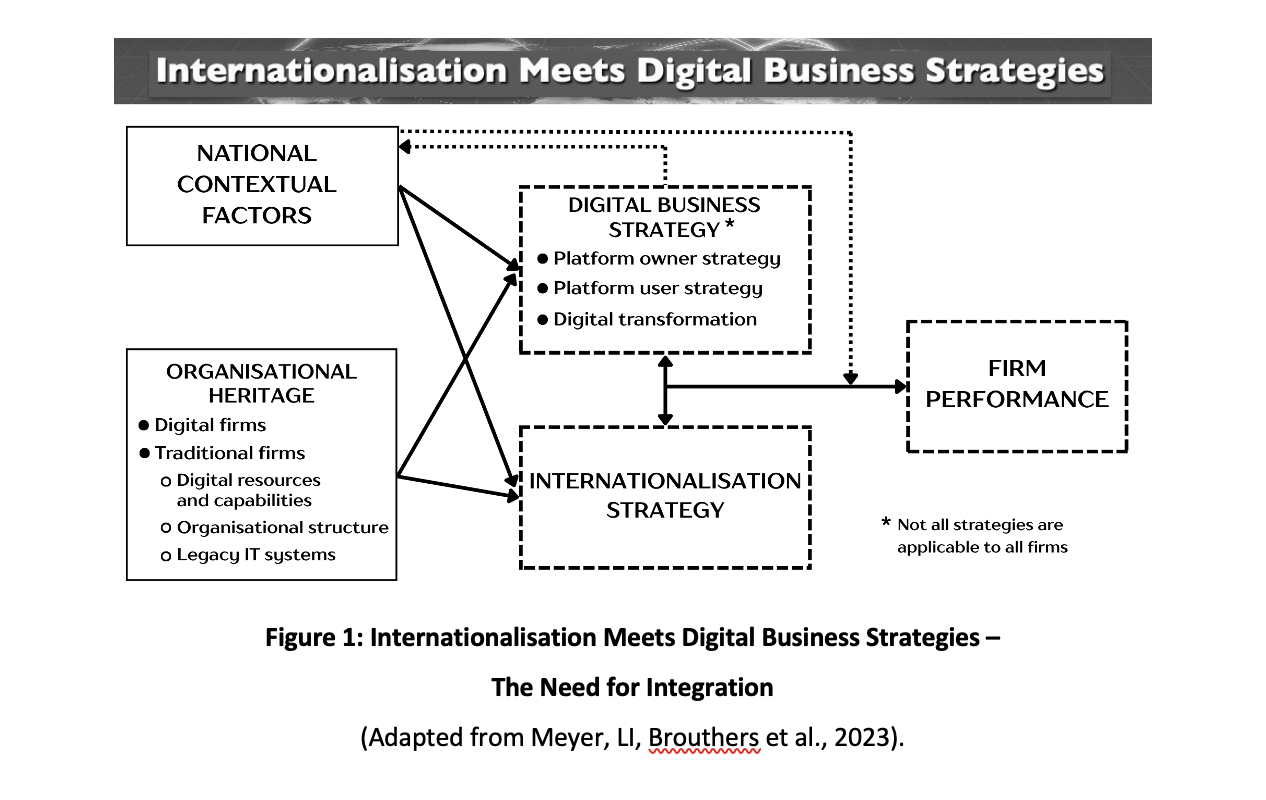
The challenge for less digitally-based international businesses will be integrating these digital and international competitive business strategies, and this can only be done over time.
NOTE: This article is developed from Willcocks, L. (2026). Global Digital Business in Uncertain Times – A Guide for The Bewildered. SB Publishing, Llanybydder, Wales. November, 2026.